Mining pools
What Are Mining Pools and How They Work
In modern cryptocurrency mining, operating in complete autonomy has become increasingly complex. The increase in network difficulty and the constant growth of global hashrate have made mining alone unsustainable…
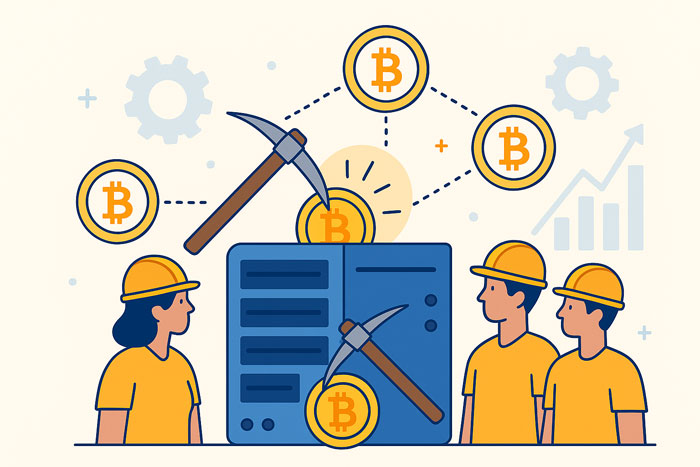
In modern cryptocurrency mining, operating completely independently has become increasingly complex. The increase in network difficulty and the constant growth of the global hashrate have made mining alone unsustainable for the majority of users. mining pools fit into this context, fundamental tools to allow miners of all sizes to actively participate in the security of blockchains.
Mining pools are aggregations of miners who decide to combine their computing power to increase the chances of finding a valid block. Instead of competing individually, participants collaborate and share rewards based on their actual contributions to the network. This approach allows you to obtain more regular and predictable profits, reducing the strong variability typical of solo mining.
The operation of a mining pool is relatively simple. The miner connects its hardware, be it ASIC or GPU, to a server managed by the pool via dedicated software. The pool assigns small computational tasks called share, which serve to measure the work performed by each participant. When one of the pool's miners finds a valid block, the overall reward is distributed among all members according to a pre-established payment method.
There are different reward distribution systems, each with specific characteristics. Some models favor the stability of payments, others more reward continuity of participation over time. The choice of payout directly affects the risk profile and predictability of earnings, making a careful evaluation essential before joining a pool.
Mining pools offer numerous benefits, including more consistent payouts, access to mining even with less powerful hardware, and advanced monitoring tools. At the same time, they present some limitations, such as the commissions applied by the pool, less individual autonomy and the risk of concentration of the hashrate in a few dominant entities. For this reason it is important to choose pools that are reliable, transparent and have a solid reputation within the community.
In the current landscape, mining pools represent an essential component of the crypto ecosystem. Without them, mining would be the exclusive prerogative of large industrial operators. Understanding what they are and how they work is therefore a key step for anyone who wants to approach mining in a conscious and sustainable way.