Hardware
How to Estimate the Real ROI of ASICs in Bitcoin Mining
Correctly estimating the real ROI of ASICs is one of the most critical aspects for those who want to invest in mining in an informed manner. Many profitability calculations present optimistic theoretical scenarios that do not take into account…
Correctly estimating the real ROI of ASICs is one of the most critical aspects for those who want to invest in mining in an informed way. Many profitability calculations present optimistic theoretical scenarios that do not take into account the operational and market variables that impact profits on a daily basis. To obtain a realistic estimate of the return on investment it is necessary to adopt a more complete and prudent approach.
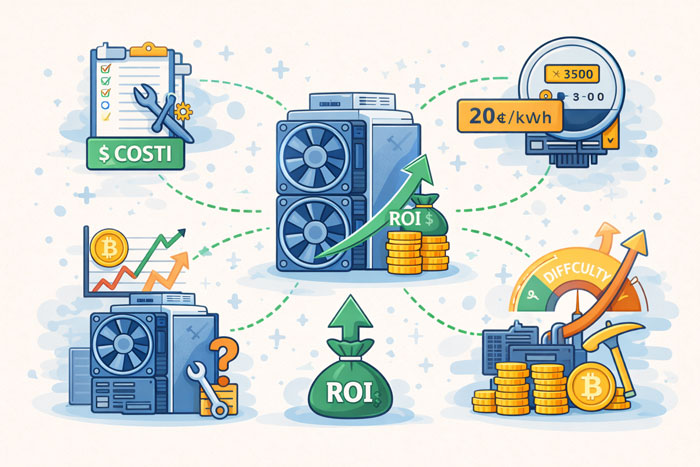
The starting point is the total cost of the hardware, which not only includes the purchase price of the ASIC, but also shipping, duties, VAT and installation costs. These initial expenses directly influence the time needed to pay back the investment and are often underestimated in superficial estimates.
The second fundamental element is the real energy cost. It is not enough to consider the nominal consumption of the ASIC: cooling, ventilation and efficiency losses due to the operating environment must also be included. Furthermore, the cost of energy can vary over time, making it necessary to calculate different scenarios to avoid surprises in the following months.
An often ignored factor is the increase in network difficulty. In Bitcoin mining, the difficulty tends to increase in the long term, progressively reducing daily revenues at the same hashrate. A realistic estimate of ROI must therefore foresee a gradual decrease in earnings, rather than assuming constant returns over time.
The price of Bitcoin also plays a key role. Although it cannot be predicted with certainty, it is advisable to calculate ROI using conservative scenarios, avoiding relying solely on bull market assumptions. This reduces the risk of unsustainable investments in the event of adverse market phases.
Finally, it is important to consider the useful life of the ASIC and its residual value. Efficient hardware can stay competitive longer and maintain resale value, improving overall ROI. On the contrary, less efficient ASICs risk becoming rapidly obsolete.
In conclusion, estimating the real ROI of ASICs means integrating initial costs, operational expenses, network evolution and realistic market scenarios. Only with a complete analysis is it possible to evaluate whether an investment in mining has real chances of success in the medium and long term.