Hardware
Comparison of Bitcoin ASICs: Efficiency, Hashrate and ROI in Modern Mining
In Bitcoin mining, choosing the right ASIC is one of the most determining factors for the success of an operation. With the constant increase in network difficulty and global competition, it is no longer enough to…
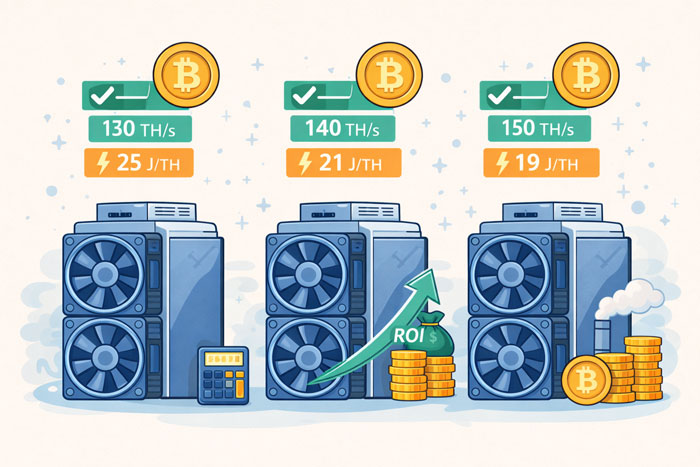
In Bitcoin mining, choosing the right ASIC is one of the most determining factors for the success of an operation. With the constant increase in network difficulty and global competition, it is no longer sufficient to focus only on the highest hashrate: today what counts above all are energy efficiency, operating cost and return on investment (ROI). An accurate comparison between the main Bitcoin ASICs allows you to avoid bad decisions and build a mining strategy that is sustainable over time.
The hashrate represents the computing power of an ASIC and is the first data that attracts attention. A higher value increases the chances of participating in the discovery of blocks, but alone does not guarantee profits. Two machines with similar hashrate can offer very different economic results if power consumption is not balanced correctly. This is where efficiency comes into play, expressed in joules per terahash, an increasingly central parameter in modern mining.
Energy efficiency determines how much energy is consumed to produce a certain amount of hashrate. New generation ASICs are able to offer superior performance by drastically reducing consumption per computing unit, making them more suitable to operate even in contexts with not particularly low energy costs. In many cases, a less powerful but more efficient ASIC is more profitable than a more powerful but energy-intensive model.
The ROI, or the time needed to recover the initial investment, is the final result of this balance. To calculate it correctly you need to consider the price of the ASIC, the electricity consumption, the cost of energy, the network difficulty and the price trend of Bitcoin. ASICs with the fastest ROI are generally those that maintain good levels of efficiency even in less favorable market scenarios, reducing the risk of returning the investment too late.
Another aspect that is often underestimated is the longevity of the hardware. More efficient ASICs tend to remain competitive for longer, while less optimized models risk becoming obsolete quickly, especially in times of increasing global hashrate. This affects not only profits, but also the resale value of the machine in the secondary market.
In conclusion, the comparison between Bitcoin ASICs cannot be limited to a simple ranking based on hashrate. Energy efficiency and ROI are today the true indicators of quality and sustainability of a miner. Only by analyzing these elements as a whole is it possible to choose the ASIC best suited to your operating conditions and approach Bitcoin mining with a realistic and strategic vision.