Regulation
EU, crypto tax reporting starts: what changes from 1 January 2026
From today the topic of "taxes and crypto" enters a more concrete and less interpretable phase: the European Union is preparing to launch, from 1 January 2026, a tax reporting mechanism designed to make the…
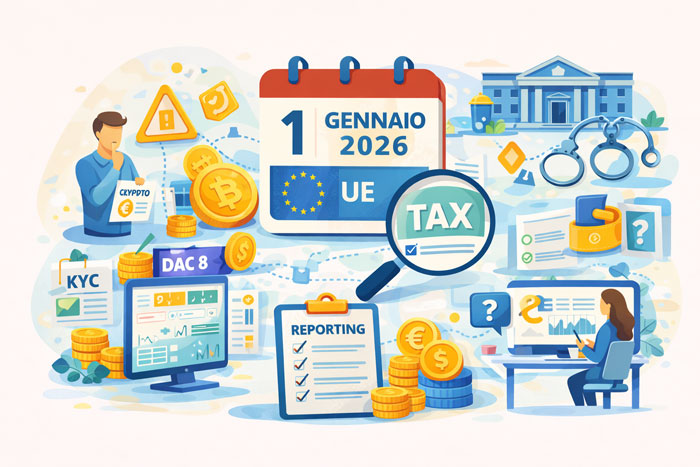
From today the topic of "taxes and crypto" enters a more concrete and less interpretable phase: the European Union is preparing to launch, from 1 January 2026, a tax reporting mechanism designed to make transactions in digital assets more traceable. It's not just another announcement: it's an operational change of pace that will involve exchanges, crypto brokers and many services that act as a bridge between the euro and blockchain.
The objective is clear: reduce gray areas, standardize data collection and allow tax authorities to trace movements more easily. Translated for those who invest: less "do it yourself" reporting, more likely that the information will automatically arrive in the control systems, especially when centralized platforms are used.
What is reporting and who does it concern
Tax reporting in the crypto sector was created to collect standardized information on users and transactions. In practice, many operators (especially centralized and regulated ones) will have to:
- identify the user in a more robust way (KYC/AML),
- link the identity to certain activities (purchases, sales, swaps, transfers in/out),
- communicate data to the competent authorities according to common schemes.
The impact is double: on the one hand the "transparency" of the market increases, on the other the responsibility of the individual investor in keeping clear accounts increases, because any discrepancies become more evident.
What can change for those who use crypto exchanges and apps
For the average user, the most important change is that many platforms may ask:
- additional identity checks,
- more precise tax residency information,
- greater consistency between profile, money flows and activities.
In parallel, requests for details on the origin of funds and destination of transfers could become more frequent, especially when moving crypto to external wallets or returning to fiat after long periods.
And what about those who use non-custodial wallets?
Having a non-custodial wallet does not "disappear" and does not become illegal, but the context changes: the wallet itself does not report, but the entry/exit ramps (exchanges, brokers, apps with IBAN, crypto cards) are increasingly incentivized to track and document. So the point becomes: how much of your journey passes through intermediaries. The more intermediaries you use, the more the information perimeter expands.
Sanctions and risks: why it is better to prepare in advance
The issue is not to scare, but to be realistic: when a law enters the executive phase, the main risks do not arise from the taxes "in themselves", but from:
- incomplete declarations,
- inconsistent data between different platforms,
- lack of documentation on purchase costs and historical movements.
In some European systems, the tightening of recovery powers can lead to very harsh measures in the event of serious or repeated violations. Even without reaching the worst case scenarios, one complaint is enough to transform months of operations into a long and expensive bureaucracy.
PepsCrypto checklist: what to do between now and the end of the year
If you want to get to 2026 "clean", here are the most useful moves:
- Download reports from all the exchanges you use (trade history, deposits, withdrawals, fees).
- Reconstruct the loading price: without purchase cost, the capital gain becomes a puzzle.
- Label the movements: transfers between your wallets are not sales, but must be demonstrated.
- If you use DeFi, keep evidence (transaction hashes, screenshots, swap/bridge notes).
- Evaluate tax tracking software if you do a lot of operations: it reduces errors and wasted time.
- Align your tax residence with the services you use: it is a detail that becomes central.
Today's point
This new reporting does not "kill" crypto: it normalizes it. And for many it is also good news, because it pushes towards a more credible and less opaque market. But for the investor it means only one thing: 2026 will reward those who treat cryptocurrencies as a real financial asset, with order, documents and tracking.