Security
Security in Cryptocurrencies
Cryptocurrencies were created to give users more freedom and control, but this comes at a price: security depends almost entirely on you. There is no bank to call, no “forgotten password” to recover funds if…
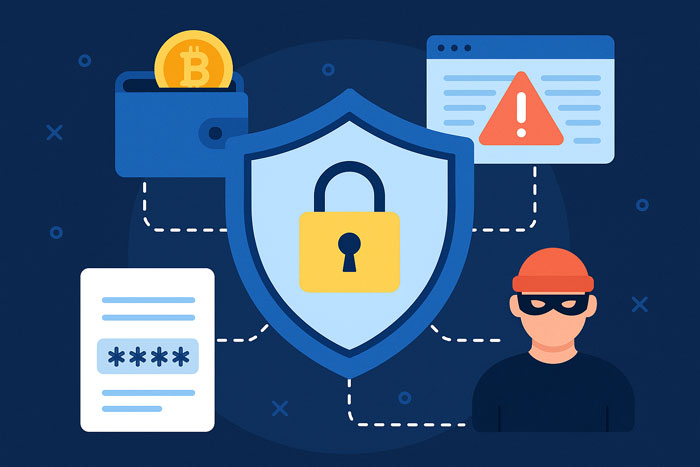
Cryptocurrencies were created to give users more freedom and control, but this comes at a price: security depends almost entirely on you. There is no bank to call, nor "forgotten password" to recover the funds if you lose your private keys or if someone steals your wallet.
This is why understanding the basics of security in the crypto world is essential, both for those starting out and for those who have been operating for a long time.
In this guide we see the main risks, the tools to use and the best practices to best protect your digital assets.
1. Why security is so critical in cryptocurrencies
In the traditional system, the bank safeguards your money and offers you protection tools: anti-fraud, partial refunds, card blocking, insurance.
In the crypto world, however:
- You are the bank.
- Private keys are your “bank account”.
- A blockchain transaction is not reversible: if you send funds to the wrong address or to a scammer, there is no "undo".
This means that errors, distractions or carelessness in security management can result in permanent losses.
The good news? With some simple rules and appropriate tools, you can greatly reduce your risk.
2. The main risks in the crypto world
To protect yourself you must first know what you are protecting yourself from. The most frequent dangers are:
2.1 Phishing
Emails, social messages or websites that imitate official exchanges and wallets to push you to:
- enter your credentials,
- share the seed phrase,
- authorize malicious transactions or connections.
All it takes is one wrong click to lose everything.
2.2 Hacking exchange accounts
Even if serious exchanges invest a lot in security, the weak point is often the user:
- weak or reused passwords
- absence of 2FA,
- accesses from infected devices.
An attack on your account may lead to a complete withdrawal of your funds.
2.3 Malware and keyloggers
Malicious programs that install on your PC or smartphone and:
- they record what you type (passwords, seeds, addresses),
- change destination addresses when you copy–paste,
- they show you fake wallets or misleading screens.
2.4 Social engineering
Scammers who exploit psychology and emotions:
- fake experts who promise guaranteed earnings if you send them crypto
- fake technical support asking for the seed phrase “to help you”,
- false giveaways: “you send 1 BTC, we'll give you 2 back”.
3. Wallets and private keys: the heart of security
The fundamental concept is: whoever controls the private keys, controls the funds.
- If you use an exchange, in many cases the keys are managed by the platform ("custodial" wallet).
- If you use a non-custodial wallet, the keys are yours alone (app, browser extension, hardware wallet).
Your seed phrase (usually 12 or 24 words) is the "master key": with that you can rebuild the wallet on any device.
For this:
- Do not photograph it.
- Do not save it unencrypted on your PC or cloud.
- Never share it with anyone (no serious support will ask you for it).
4. Hot wallet vs cold wallet
To manage security, it is important to understand the difference between:
4.1 Hot wallet
Internet-connected wallets:
- app on smartphone,
- browser extensions (e.g. for DeFi and Web3),
- wallet on exchange.
They are convenient to operate and trade, but more exposed to attacks.
4.2 Cold wallet
Offline wallets, usually hardware wallets (such as dedicated sticks) or cold storage solutions:
- private keys never enter directly into a connected device
- even if the PC is infected, the attacker cannot "see" the keys.
The most prudent strategy is:
- use a hot wallet for the operational part (small amounts),
- hold the major portion of funds in cold wallets for the long term.
5. Good personal safety practices
The first defense is you. Here are some basic rules to always apply:
5.1 Strong and unique passwords
- Use long, complex and different passwords for each service.
- Do not reuse the same password across multiple exchanges or emails.
- Entrust a reliable password manager to manage them.
5.2 Two-factor authentication (2FA)
Always enable 2FA:
- prefer apps like Google Authenticator or Authy,
- avoid 2FA via SMS when possible (more vulnerable to SIM swap).
5.3 Safe backups
- Write the seed phrase by hand on paper or resistant supports (metal plates also exist).
- Keep backups in safe, separate locations (e.g. two different places).
- Do not share them with anyone, not even friends or family "for convenience".
5.4 Updated and cleaned devices
- Keep your operating system and apps up to date.
- Use a good antivirus/antimalware.
- Do not install pirated or suspicious software.
- Before managing large amounts, avoid public Wi-Fi networks and prefer secure connections.
6. Security on exchanges
If you decide to leave part of your cryptocurrencies on an exchange:
- Choose platforms with good reputation, licenses and proven security.
- Activate all available security features:
- 2FA,
- whitelist of withdrawal addresses,
- email/SMS notifications for logins and withdrawals.
- Do not leave more funds on the exchange than necessary for daily trading.
Remember the golden rule:
“Not your keys, not your coins.”
7. DeFi, Web3 and wallet permissions
When you connect your wallet to DApps, DeFi protocols or NFT marketplaces:
- Always check the URL (watch out for clone sites).
- Check the permissions you are granting (e.g. "spend" a token unlimitedly).
- Periodically revoke unnecessary permissions using “token approvals” tools when available.
- Be wary of projects that promise unreal returns in a short time.
8. Mistakes to absolutely avoid
To summarize, there are some typical mistakes that should be avoided at all costs:
- Take a screenshot or photo of the seed phrase.
- Send the seed phrase to someone on Telegram, email, chat or web form.
- Store seeds and passwords in unencrypted files on your PC or cloud.
- Clicking links received from unverified “support” or “assistance”.
- Be guided by haste, fear of "missing the opportunity" or FOMO.
9. Building a true safety mindset
Security in cryptocurrencies is not just a list of rules, but a way of thinking:
- always doubt offers that are too good to be true
- Check calmly before acting,
- update on new scams and threats,
- treat every operation as if there were no "second chance".
With this approach and the right tools, you can enjoy the advantages of the crypto world while drastically reducing the risk.