Regulation
When traditional finance gets stuck: why tokenization is no longer an option but a necessity
The blackout of the CME Group, the largest derivatives exchange in the world, has reopened a debate that in crypto circles has long been considered closed: can centralized financial systems really guarantee the reliability…
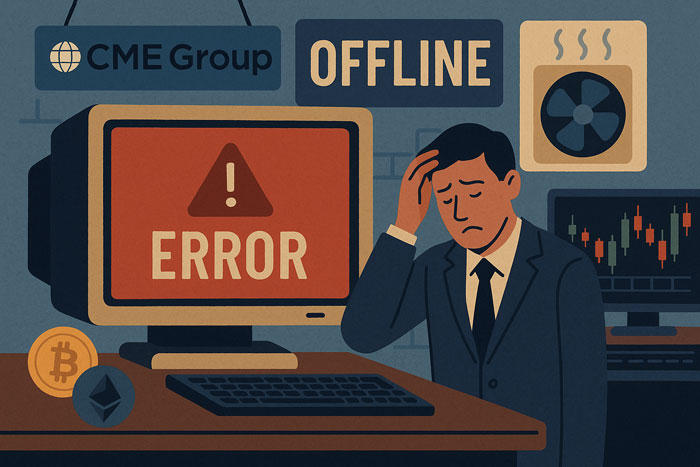
The blackout of the CME Group, the largest derivatives exchange in the world, has reopened a debate that in crypto circles has been considered closed for some time: can centralized financial systems really guarantee the reliability they promise?
The answer, after the more than 12 hours offline recorded yesterday, seems less obvious than usual.
The CME is not just any exchange: futures on raw materials, stock indices and even the main Bitcoin and Ethereum futures contracts pass here. In other words, it is the most critical infrastructure of the global derivatives market. Yet, a malfunction of the cooling systems was enough to block it completely.
Bitcoin and Ethereum: textbook uptime
The CME blackout had an involuntary but significant effect: it reminded everyone that systems like Bitcoin and Ethereum, while considered "slow" compared to many new blockchains, have an almost impeccable track record of continuity.
- Ethereum has never had a true offline in ten years of history. Even during DoS attacks (like in 2016) or difficult moments between historical updates, the network has always remained operational.
- Bitcoin, except for a 6-hour chain split in 2013 – when it was still in its pioneering years – has never suffered an interruption comparable to those of large traditional markets.
The paradox is evident: decentralized systems, often described as inefficient, actually prove to be more reliable than the centralized giants of global finance.
Centralization: speed or fragility?
The CME is a perfect example of this dilemma.
Centralization allows speed, efficiency, coordination. But it also concentrates the risks: if the heart stops, everything stops.
In contrast, slower and more robust blockchains demonstrate that redundancy and decentralization protect the system from complete crashes.
The critical point is finding the right balance. An “on-chain” CME would not be realistic: Bitcoin could not process the load of transactions required by such a market.
But continuing to rely on centralized and opaque infrastructures exposes global markets to growing vulnerabilities.
Tokenization as a possible hybrid solution
Many current discussions point towards a hybrid model, in which:
- Markets remain centralized at the basic operational level (necessary to ensure market speed and depth).
- Transactions are then recorded in batches on public or permissioned blockchains, to increase transparency, auditability and resilience.
This scheme could guarantee:
- greater systemic security,
- reduction of failure points,
- a "measured" decentralization, compatible with the volumes of traditional markets.
However, it introduces a new question.
Liquidity: the real crux of the revolution
The CME dominates because it concentrates liquidity: traders, market makers, institutions and hedgers all operate in the same place.
If tokenization were to create an ecosystem with multiple parallel markets - each registered on blockchain but not necessarily unified in operation - what would happen to liquidity?
- Would it be dispersed?
- Would new inefficiencies be created?
- Would institutions accept a less centralized, even if more resilient, market?
These are questions that remain open and will define the future of on-chain finance.
Conclusion
The CME blackout was not just a technical accident: it was a reminder.
Traditional finance, however efficient and sophisticated, is not immune to structural errors.
Blockchain technology does not represent a total replacement, but a necessary evolution towards more secure, transparent and resilient systems.
Tokenization is no longer a futuristic experiment: it is the logical step on the global financial path.
But like all revolutions, it will require compromises, new rules and a profound rethinking of what “liquid market” means in the decentralized world.