Regulation
The Trump family's crypto seeks US banking license: breakthrough for stablecoins
In the crypto world, 2026 is opening with a signal that is worth more than a thousand "bullish proclamations": one of the most discussed initiatives in the ecosystem, World Liberty Financial, linked to the Trump family, would have presented...
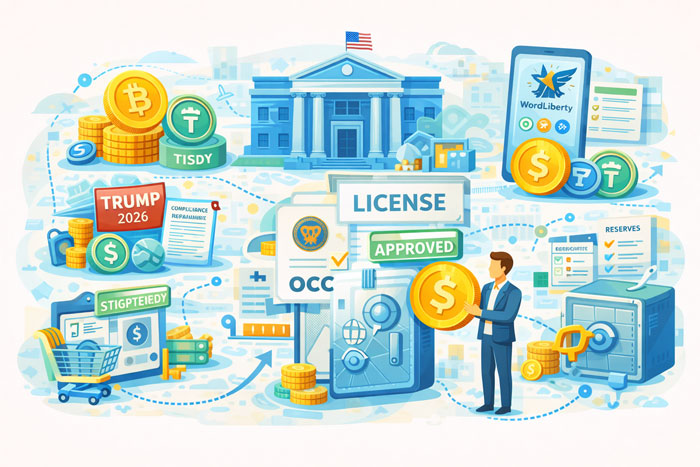
In the crypto world, 2026 is opening with a signal that is worth more than a thousand "bullish proclamations": one of the most discussed initiatives in the ecosystem, World Liberty Financial, linked to the Trump family, has reportedly submitted an application to obtain a federal banking license in the United States (a form of "national bank trust charter"). If confirmed and approved, it would not be a technical detail: it would be a change in level, because it would move part of the crypto operations to a perimeter closer to that of traditional financial players.
Why a banking license is huge news
In the crypto sector, “regulation” is often perceived as a brake. In reality, for many companies it is the opposite: a license can become a competitive advantage, because it reduces uncertainty, opens institutional channels and allows services to be offered with a more stable regulatory framework.
A banking license (or trust charter) is not “just a sticker”. It can mean:
- a single federal supervisor, instead of state mosaics and fragmented interpretations
- greater credibility towards partner banks, payment circuits and corporate customers
- possibility of structuring services such as custody, conversion and, above all, issuance/management of stablecoins in a more "clean" way
In practice: if the heart of the business is to move digital dollars in a reliable way, staying within a banking perimeter can make everything more scalable.
The stablecoin node: the real game of 2026
If we look at where liquidity is going, the issue is not just Bitcoin or altcoins: it is stable money. Stablecoins are becoming the "binary" with which payments, trading and global settlement are regulated 24/7. But precisely because they are increasingly central, they also become the most sensitive area for regulators.
The license application comes in a context in which the United States is trying to tighten:
- reserve and risk management requirements
- transparency and operational controls
- separation between company funds and client funds
- custody and conversion responsibilities
PepsCrypto translation: in 2026, it will not be whoever "prints" the noisiest stablecoin who will win, but whoever proves they can manage it with real finance standards.
What could change for users and the market
If a crypto operator obtains a banking classification, the effects can be concrete:
1) More "institutional" custody
More procedures, more audits, more internal controls. For the user it means less improvisation, but also more KYC requests and checks.
2) More integrated payments and conversions
With a regulated structure it becomes easier to build bridges towards merchants, fintechs and large companies. It is the transition from "crypto for crypto" to "crypto as infrastructure".
3) Competition that shifts to compliance
Those who remain outside of licenses and standards could find more obstacles: more distrustful partners, stricter banking limits, higher compliance costs.
The key point: it's not just politics, it's market architecture
Beyond the names, this news should be read as a signal of maturation: crypto is trying to enter the control room not with slogans, but with legal instruments. It is an attempt to make crypto operations "native" within rules designed for customer protection, solidity and responsibility.
And this also brings an inevitable consequence: if the ecosystem moves towards banking models, guarantees increase, but constraints and traceability also increase. It is the price (and benefit) of integration.
Reading PepsCrypto
The license application is not a "graphic" event, it is an infrastructure event. If 2025 was the year stablecoins demonstrated utility, 2026 could be the year we decide who is allowed to operate them on a large scale in the United States. And whoever arrives first with a regulated structure could gain a huge advantage in the global payments and settlement market.