Indicators & signals
How to Read Trading Signals: The Essential Basics
Understanding how to read trading signals is one of the most important steps for those who want to operate with awareness in the world of cryptocurrencies. Signals are nothing more than indications generated by technical analysis…
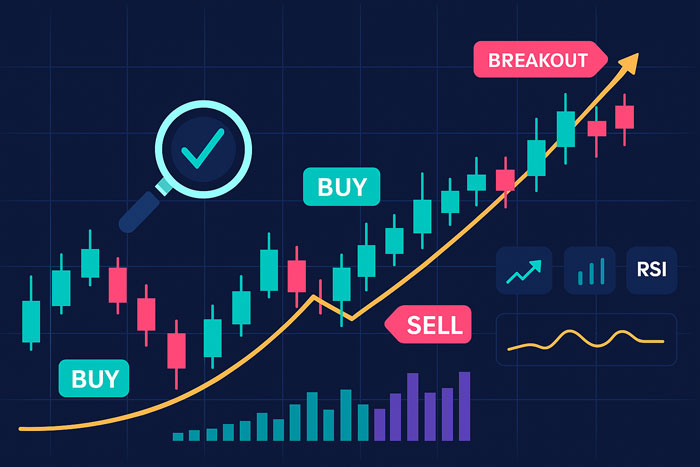
Understanding how to read trading signals is one of the most important steps for those who want to operate with awareness in the world of cryptocurrencies. Signals are nothing more than indications generated by technical analysis or predefined strategies, designed to suggest when to enter or exit a trade.
These signals can come from indicators, chart patterns, volumes or from the interaction between different analytical tools.
In the extremely volatile crypto market, reading signals correctly can make the difference between a profitable trade and a significant loss. However, it is essential to remember that no signal is infallible: what matters is to interpret them in the right context and integrate them into a well-structured strategy.
What are trading signals
A trading signal is a trading indication that suggests a potential action, such as:
- Buy
- Sell
- Partial or total exit
- Hold the position
These signals can be generated manually by the trader or automatically by indicators and algorithmic systems. Their purpose is to help identify moments in the market where the probability of success is most favorable.
Most common types of signals
1. Trend-based signals
The trend is the dominant direction of the market. A buy signal emerges when the price confirms a bullish trend, while a sell signal occurs in the presence of a bearish trend.
Examples: Moving Averages, Supertrend, MACD.
2. Reversal signals
They indicate a possible change in price direction.
Examples: RSI/MACD divergences, patterns such as double top and double bottom.
3. Breakout signals
When the price breaks above a key level (support or resistance), it can mean a strong move is starting.
Examples: Breaking resistance on high volume.
4. Overbought / oversold signals
Indicators such as RSI and Stochastic can signal when the market is too extended up or down, suggesting a possible correction.
How to correctly interpret trading signals
1. Use multiple confirmations
A single indicator can generate false signals. Using two or three sources of confirmation reduces the risk of error.
2. Consider the market context
In sideways markets, many trend-based signals can prove ineffective. Understanding the context is key.
3. Don't ignore volumes
A signal without an increase in volume may not be reliable. The volumes confirm the strength of the movement.
4. Set up risk management
Each signal must be accompanied by stop-loss, take-profit and a position management plan.
Common mistakes to avoid
- Rely exclusively on one indicator.
- Enter impulsively without confirming the signal.
- Ignore macroeconomic or market news.
- Overload the chart with too many indicators.
Reading trading signals requires practice and discipline, but it is one of the key skills to operate professionally in the crypto market.
Conclusion
Knowing how to correctly interpret trading signals allows you to make more informed decisions and increase the probability of profitable operations. It is a skill that improves with experience, knowledge of tools and the ability to remain emotionally detached.
For a crypto trader, this is one of the essential foundations for building a solid and sustainable strategy.