Security
How to Safely Set Up Seed Phrase and Backup Keys
In the world of cryptocurrencies, all your digital wealth boils down to one thing: the ability to reconstruct your private keys. This possibility is concentrated in a few words: the seed phrase (or secret phrase of...
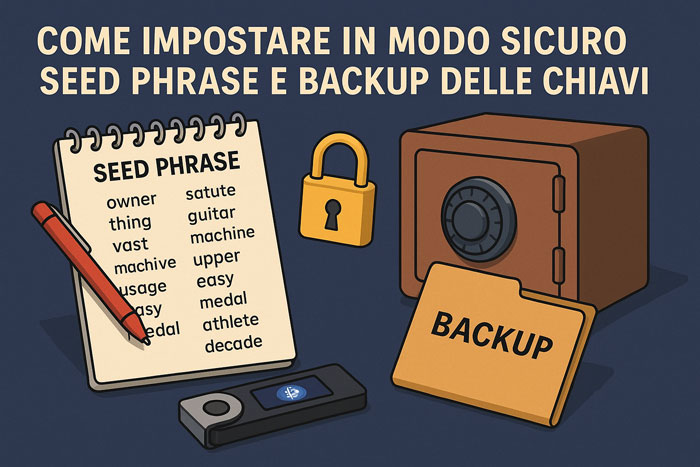
In the world of cryptocurrencies, all your digital wealth boils down to one thing:
the ability to reconstruct your private keys.
This possibility is concentrated in a few words: the seed phrase (or secret backup phrase).
If someone obtains it, they can empty your wallet.
If you lose it, you lose access to your cryptocurrencies forever.
For this reason, it is essential to know how to generate it, store it and make backups in a truly secure way.
1. What is a seed phrase and why is it so important
The seed phrase is a sequence usually of 12 or 24 words generated by the wallet at the time of creation.
- From these words you can derive all the private keys and therefore all the addresses of your wallet.
- It's a master backup: with the seed you can restore the wallet on another device, even if the phone or hardware wallet is lost or broken.
In practice:
Seed phrase = total access to your crypto assets.
2. Generate the seed phrase correctly
Usually the seed is generated automatically by the wallet (software or hardware).
Some good practices:
- Peaceful and private environment
- Do it in a place where no one can look at the screen or film you.
- No active cameras, camcorders, streaming.
- Reliable device
- If you use a software wallet, make sure your device is clean, up-to-date and free of malware.
- For large amounts, it is preferable to directly use a hardware wallet.
- Do not take photos or screenshots
- Images can end up in the cloud, automatic backups or stolen by malware.
When the wallet displays the seed phrase, take the time necessary to write it down with maximum precision.
3. How to write the seed phrase
correctlyThe seed must be written by hand, ideally more than once:
- Use good quality paper or, better yet, more resistant supports (metal plate, steel cards).
- Write legibly, without shortening or distorting words.
- Copy the seed twice and compare word by word.
Many wallets ask you immediately afterwards to confirm some words in precise positions: it is a first check that you have written everything correctly.
4. Backup strategy: where and how to store it
The most common mistake is having just one piece of paper kept somewhere in the house.
Better to think about a real strategy:
- At least two physical copies
- One at home, in a place that is difficult to access and not obvious.
- A second copy in a separate place (e.g. safe, home of a trusted family member, etc.).
- Protection against theft, fire and loss
- For large amounts, consider fire and water-proof supports, such as metal plates with engraved or punched words.
- No digital seeds
- Avoid text files, photos, PDFs, phone notes, emails - they are easy to copy or steal in bulk.
- Absolute discretion
- Don't talk publicly about where you keep your backups.
- Avoid obvious clues (“CRYPTO folder” in the drawer…).
5. Additional passphrase: an extra level of protection
Many wallets allow you to add a passphrase (additional word or phrase) to the seed.
It works like this:
- Seed phrase + correct passphrase → access the real wallet.
- Seed phrase without passphrase → access an “empty” or different wallet.
Advantages:
- If someone were to obtain "only" the seed, without the passphrase they would still not have access to the main funds.
- Useful for dividing main assets and small front sums.
Be careful though:
- If you forget your passphrase, not even the seed will help you recover the funds.
- It should be managed with the same (or greater) level of care as the seed.
6. Test the backup: restore test
A backup is only really good if you've verified that it works.
Recommended procedure:
- Create a new test wallet on another device (or resetting an empty hardware wallet).
- Select “restore from seed phrase”.
- Enter the words one by one, in the correct order.
- Check that addresses and balance match with the original wallet.
This step gives you the certainty that:
- you transcribed the seed without errors,
- you actually know how to restore the wallet in case of emergency.
7. Mistakes to avoid with seeds and key backup
Here is a list of things to never do:
- Take a photo or screenshot of the seed phrase.
- Save seeds or private keys in unencrypted files on your PC or cloud.
- Send them via email, chat, Telegram or any online channel.
- Dictate the seed on the phone to someone, even if you are a friend or "expert".
- Keep the only copy of the seed in the same place as the device (e.g. paper in the drawer next to the hardware wallet).
- Destroying the only copy "out of fear" without having another safe one.
8. Succession planning: what happens if something happens to you
If you manage large sums, it is wise to ask yourself:
“If something happens to me, will someone trustworthy be able to recover the funds?”
Some ideas:
- Leave instructions in a clear will or legal document (without perhaps writing the seed directly, but explaining where to find it and how to use it).
- Divide information between multiple trusted people (e.g. backup location + instructions for use).
- Use multi-sig solutions, where multiple keys are needed to move funds.
The goal is to find a balance between security (not making everything too easy for an attacker) and recoverability for your loved ones.
9. The right mindset: treat the seed like a safe
In the end it's about changing mentality:
- Treat seeds and backup keys as if they were gold bars.
- Every time you think about “comfort” ask yourself if you are sacrificing too much security.
- Periodically update your strategy (new devices, new places, new needs).
With a well-set seed phrase and detailed key backups, the most fragile part of your crypto setup finally becomes solid and reliable.