Security
Two-Factor Authentication (2FA): Why It Is Indispensable in Crypto
In the traditional world, if someone hacks into your online account you can still call the bank and try to stop the damage. In the crypto world, however, once the funds leave your wallet they never come back. For…
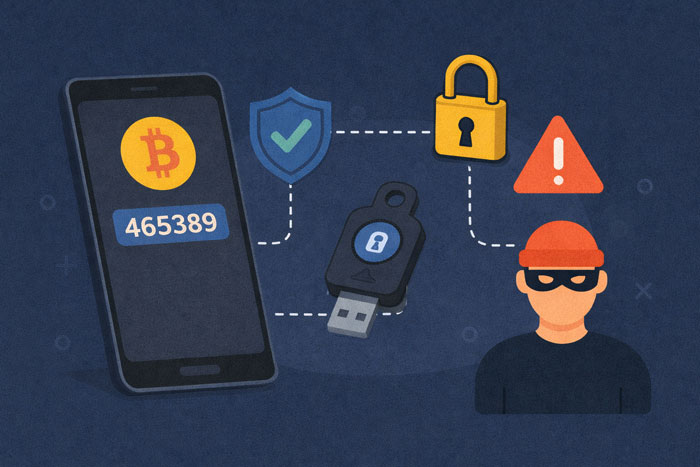
In the traditional world, if someone enters your online account you can still call the bank and try to stop the damage.
In the crypto world, however, once the funds leave your wallet they never come back.
This is why every additional level of security makes a difference, and among all the tools at your disposal there is one that you should activate everywhere immediately: two-factor authentication (2FA).
What is 2FA and how it really works
2FA adds a second mandatory step to the normal login with email/username and password.
Basically, to enter your account you must demonstrate two things:
- Something you know – the password.
- Something you have – a temporary code generated or sent to a device you own.
Even if someone guesses or steals your password, without the second factor they cannot complete the login.
Why is it so important in the crypto world
Accounts linked to cryptocurrencies - exchanges, custodial wallets, email linked to accounts, trading apps - are privileged targets for hackers and scammers:
- contain direct value (your cryptocurrencies),
- allow you to change withdrawal addresses
- They are often connected to multiple services.
A single violation can mean total loss of funds.
2FA makes this scenario much more difficult, because:
- a database of stolen passwords is not enough
- Keystroke logging malware is not enough
- those who try to enter must also overcome the second obstacle.
Types of 2FA: they are not all the same
Not all forms of two-factor authentication offer the same level of security. The main ones are:
1. 2FA via SMS
Receive a 6-digit code via message on your phone.
Pros:
- Simple to understand and use.
- Does not require additional apps.
Cons:
- Vulnerable to SIM swap attacks (a scammer convinces the operator to move your number to a SIM under his control).
- SMS can be intercepted or delayed.
Better than nothing, but not the ideal solution for important assets.
2. Authentication app (TOTP)
You use apps like Google Authenticator, Authy or similar that generate temporary codes (TOTP) that are valid for a few seconds.
Pros:
- Much safer than SMS.
- They do not depend on the telephone network.
- They also work offline, as long as the device clock is synchronized.
Cons:
- If you lose your phone and have no backup, you risk losing access to your accounts (recovery codes or alternative procedures are always needed).
For most users, this is the best combination of security and convenience.
3. Physical security keys (U2F / FIDO)
USB or NFC devices (such as YubiKey) that confirm access with a physical press.
Pros:
- Even higher level of security.
- They resist phishing better: the device checks the site before authorizing access.
Cons:
- They cost more.
- They require a little more configuration.
- Not all services support them.
They are the ideal choice for those who manage large capital or critical accounts.
Where to activate 2FA in crypto
If you trade with cryptocurrencies, there are some places where 2FA should be mandatory:
- Cryptocurrency exchange: login, withdrawals, change of addresses.
- Custodial wallets and trading apps.
- Main email used for registrations and password recovery: if an attacker gets your email, they can reset many services.
- Any cloud where you keep sensitive documents (although you should avoid saving seeds and keys digitally).
The more layers you protect, the more difficult it becomes for an attacker to chain accesses.
2FA and phishing: beware of fake "secure logins"
2FA doesn't make you invincible if you fall into well-made phishing traps.
Typical example:
- You receive an email or message urging you to click on a link (fake exchange, fake login page).
- Enter your username, password and even your 2FA code.
- The malicious site forwards data in real time to the real site and takes control of your account.
How to defend yourself:
- Always type the URL by hand or use saved bookmarks.
- Check the certificate and address in the browser bar.
- Be wary of alarmist emails with urgent tones (“Your account will be closed in 24 hours!”).
2FA works best if you also adopt prudent and aware behavior.
Good practices for truly effective 2FA
To make the most of 2FA in the crypto world:
- Prefer authentication apps or physical keys over SMS.
- Carefully keep the backup codes provided by the services when you activate 2FA.
- Never share screenshots of QR codes or setup screens.
- If you change your phone, make sure you transfer the 2FA app correctly before resetting your old device.
- In case of problems, always check the official recovery procedures and do not rely on fake supports on social media.
2FA as part of a broader strategy
Two-factor authentication is a pillar, but it is not enough on its own:
- you need a strong and unique password for each service
- we need clean and updated devices,
- correct management of seed phrases and backups is required.
Think of 2FA as the second lock on the safe door: without the first one (strong password) or strong walls (general good practices), the protection weakens.
Conclusion: why it is truly indispensable
In crypto, where there are no refunds or automatic insurance, the difference between those who are emptied and those who remain safe is often a six-digit code.
Enabling 2FA on all your critical services is one of the simplest and most powerful steps you can take today to protect:
- your funds,
- your digital identity,
- the serenity with which you move in the world of cryptocurrencies.