Regulation
Australia, stop at NGS Crypto: only 6.7M recovered out of 59M collected
Today news arrives from Australia that sounds like a harsh but useful reminder for the entire sector: the Federal Court has ordered the liquidation of NGS Crypto and other related entities, after an investigation that lasted…
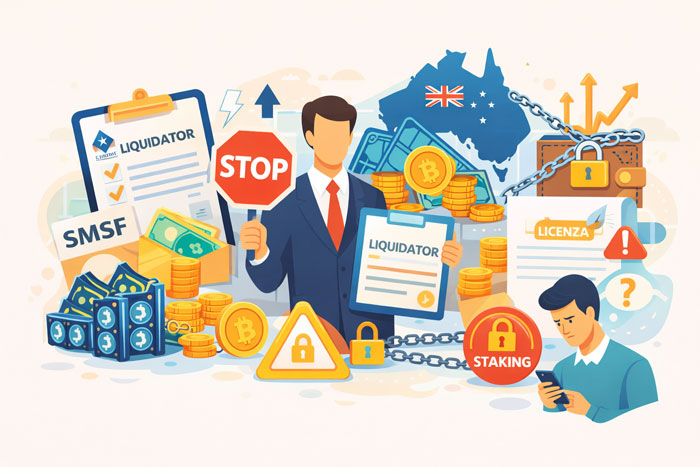
Today news arrives from Australia that sounds like a harsh but useful reminder for the entire sector: the Federal Court has ordered the liquidation of NGS Crypto and other related entities, after an investigation that lasted months and a framework that - as it is described - brings together aggressive marketing, promises of returns and failed legal protections.
The case is important not only for the numbers, but for the type of mechanism: an offer of "packages" linked to blockchain mining with declared fixed returns (in some materials there was even talk of double-digit returns) and a "guided" path to flow money into the scheme. The detail that struck observers the most is that many investors would have been pushed to use self-managed superannuation funds (SMSF), an instrument which in Australia has precise rules and which, precisely by its nature, requires even more stringent levels of transparency and compliance.
What happened and why it is "regulatory" news
The court considered that the companies involved had operated financial services without the required authorizations and that the scheme presented characteristics compatible with operations not in compliance with the rules protecting the public. Hence the most drastic decision: operational stop, appointment of liquidators and start of the procedure to reconstruct the flows and distribute what will be recoverable.
In these cases the point is not just "who is wrong", but how the mass is rebuilt and how long it takes to do so. And this is where the story becomes particularly instructive for those who invest in crypto: so far only the equivalent of around 6.7 million has been identified, compared to a total estimated at around 59 million raised by hundreds of investors. In practice, a limited portion compared to the overall.
The most "crypto" node of the case: pseudonymous wallets and blocked funds
When a transaction ends up in court in the traditional world, the hunt for funds passes through bank accounts, intermediaries, wire transfers and reporting. In the crypto world the situation is different: assets can be fragmented across multiple addresses, moved quickly and stored pseudonymously. This makes traceability potentially possible, but the identification of ownership and the concrete ability to "hook" those assets to a subject or legal availability is often more complex.
Then there is an even more delicate element: a part of the identified funds would be staking, with time constraints which - in some cases - could make the assets not immediately liquidatable and even blocked for many years. It is a scenario that makes us understand how, in crisis situations, an apparently "technical" operation (staking, lockups, protocols with unbonding periods) can transform into a legal and practical problem: even if "the funds exist", recovering them may not be immediate.
Why the liquidation matters more than the media hype
When we talk about cases like this, the focus often turns to headlines and outrage. But the part that really matters for investors is what happens next: who manages the procedure, what powers they have, which assets are already under control, and which ones still need to be identified.
The appointment of liquidators serves a specific objective: to bring order, freeze what can be frozen, reconstruct the steps and try to maximize returns. At the same time, precautionary measures and personal restrictions may remain active to prevent further dispersions. It is the "machine" with which a system tries to repair damage that has already occurred.
The lesson for investors: three signals not to ignore
At PepsCrypto, we also take it as a practical checklist. Three alarm bells emerge forcefully:
- Fixed "guaranteed" returns in mining
Mining (and more generally any activity linked to network revenues) thrives on variables: asset price, difficulty, energy costs, hardware, operational management. If someone promises fixed and predictable returns as if it were a bond, double caution is needed. - Structures that "guide" the investor towards complex instruments
If to invest you are suggested to create vehicles, dedicated accounts or pension/self-managed structures without a clear picture, stop. The apparent "professionalism" of the process can only be a way to increase trust. - Opacity on custody and controls
Who holds the keys? Where do the funds go? Is there an independent report? Is there asset segregation? In a mature market these questions are standard. If the answers are vague, it's a risk.
Impact on the sector
Cases like this push the authorities to make two almost automatic moves: raise the control threshold and tighten expectations on transparency and licenses, especially when savers and social security instruments are involved. For serious companies, in the medium term, it is also a "cleaning" of the market: less space for opaque schemes, more space for operators with clear procedures, audits and compliance.
For users, however, it is an invitation to change their mentality: in crypto it is not enough to ask "how much it makes", you have to ask yourself "what happens if something goes wrong". Because when things go wrong, between wallets, lockups and jurisdictions, getting the funds back can become a marathon.