Trading strategies
Exchange Arbitrage: The Strategy for Exploiting Price Differences
Arbitrage between exchanges is one of the oldest and at the same time most effective strategies in cryptocurrency trading. It is based on a simple but powerful principle: exploiting price differences of the same asset…
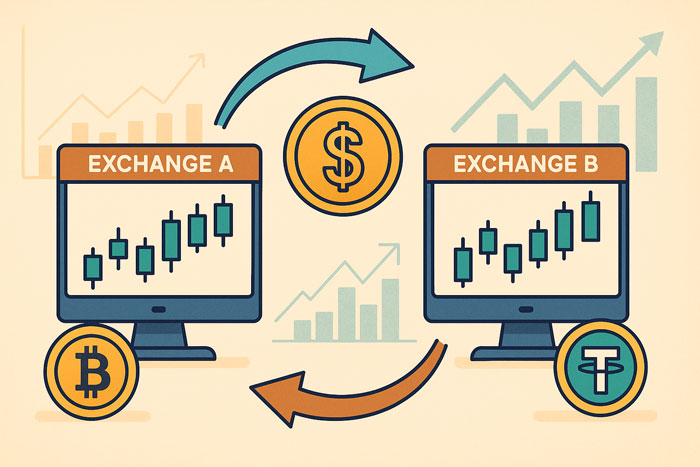
Arbitrage between exchanges is one of the oldest and at the same time most effective strategies in cryptocurrency trading. It is based on a simple but powerful principle: exploit price differences of the same asset between different exchange platforms.
Since the crypto market is extremely fragmented and each exchange has its own liquidity, it is common to see Bitcoin, Ethereum or other cryptocurrencies with slightly different prices from one platform to another.
Arbitrage allows you to transform these discrepancies into quick and relatively low-risk profits, as long as you operate with precision and speed.
What is Exchange Arbitrage?
Arbitrage consists of buying a cryptocurrency on an exchange where it costs less and selling it on another exchange where it costs more, keeping the difference as profit.
Simple example:
- BTC on Binance = $30,000
- BTC on Kraken = $30,200
Potential profit = $200 per BTC
These types of differences are common, especially in times of high volatility.
Why Arbitrage is so effective in the crypto market
The cryptocurrency market does not have a single global price.
Each exchange manages:
- your own order book
- your liquidity level
- your own trader flow
This creates opportunities that are now rare in traditional markets (such as shares and ETFs).
Other factors that create price differences:
- extreme volatility
- different time zones
- uneven supply and demand
- variable commissions
- delays in price updates
For a scalper or opportunistic trader, this is fertile ground.
Types of Arbitrage in the Crypto world
There are different forms of arbitrage, some simple, others more advanced.
1. Simple arbitrage between exchanges
The best known form: buy on one exchange, sell on another.
2. Triangular arbitrage
It involves three currency pairs within the same exchange.
Example: BTC → ETH → USDT → BTC
Imbalances in conversion rates are exploited.
3. Statistical arbitrage
Based on algorithms that identify anomalous deviations from average prices.
4. Arbitrage with futures
You buy spot on an exchange and open an opposite (short) position on futures when there is a strong differential between the spot price and derivatives.
5. Decentralized arbitrage (DEX vs CEX)
Differences between centralized exchanges and DeFi platforms such as Uniswap, PancakeSwap or Curve are exploited.
Practical example
Suppose USDT is worth:
- $1.00 on Exchange A
- $0.98 on Exchange B
A trader can:
- Buy USDT on Exchange B
- Transfer it to Exchange A
- Resell it for $1.00
With a net margin of 2% (after commissions).
In sideways markets or during highly volatile events, these opportunities can repeat several times a day.
Advantages of Arbitrage between Exchanges
- Relatively low risk compared to directional trading
- Quick profits and often repeatable
- Does not require market forecasts
- Can be automated with bot
- Works well in volatile markets
Disadvantages of Arbitrage
- High fees can eat away at your profits
- Transfer times (especially on-chain) can nullify the opportunity
- Need for capital distributed across multiple exchanges
- Possible withdrawal limits or temporary blocks
- High competition with professional bots
For this reason, many arbitrageurs use APIs and automations to be faster than the market.
Arbitrage vs other strategies
| Strategy | Dependency on trend | Risk | Activity |
|---|---|---|---|
| Arbitrage | Low | Low-Medium | Medium |
| Scalping | High | High | Very high |
| DCA | None | Low | Low |
| Swing Trading | Medium | Medium | Medium |
Arbitrage is ideal for those who prefer stable and non-speculative profits.
Conclusions
Arbitrage between exchanges is a powerful and still very effective strategy in the crypto world. Due to the volatility and fragmentation of the market, it offers quick profit opportunities without having to predict the price trend.
However, it requires attention to fees, network times and technical configuration. With the right tools, it can become one of the most profitable and consistent strategies for a trader.